
Quercetin and ALDH2: An Open Question
There is a compound in grape skins that most people have never heard of, and an enzyme in the human body that a great many scientists have spent careers on. In late 2023 a study put the two in the same room.
What came out of it is not an answer. It is a good question, and it is one that starts in the vineyard rather than the cellar, which is why it has our attention.
First, the compound
Quercetin is a flavonol. It is not exotic and it is not unique to wine. There is quercetin in onions, capers, apples and tea, usually in larger amounts than you would find in a glass of anything.
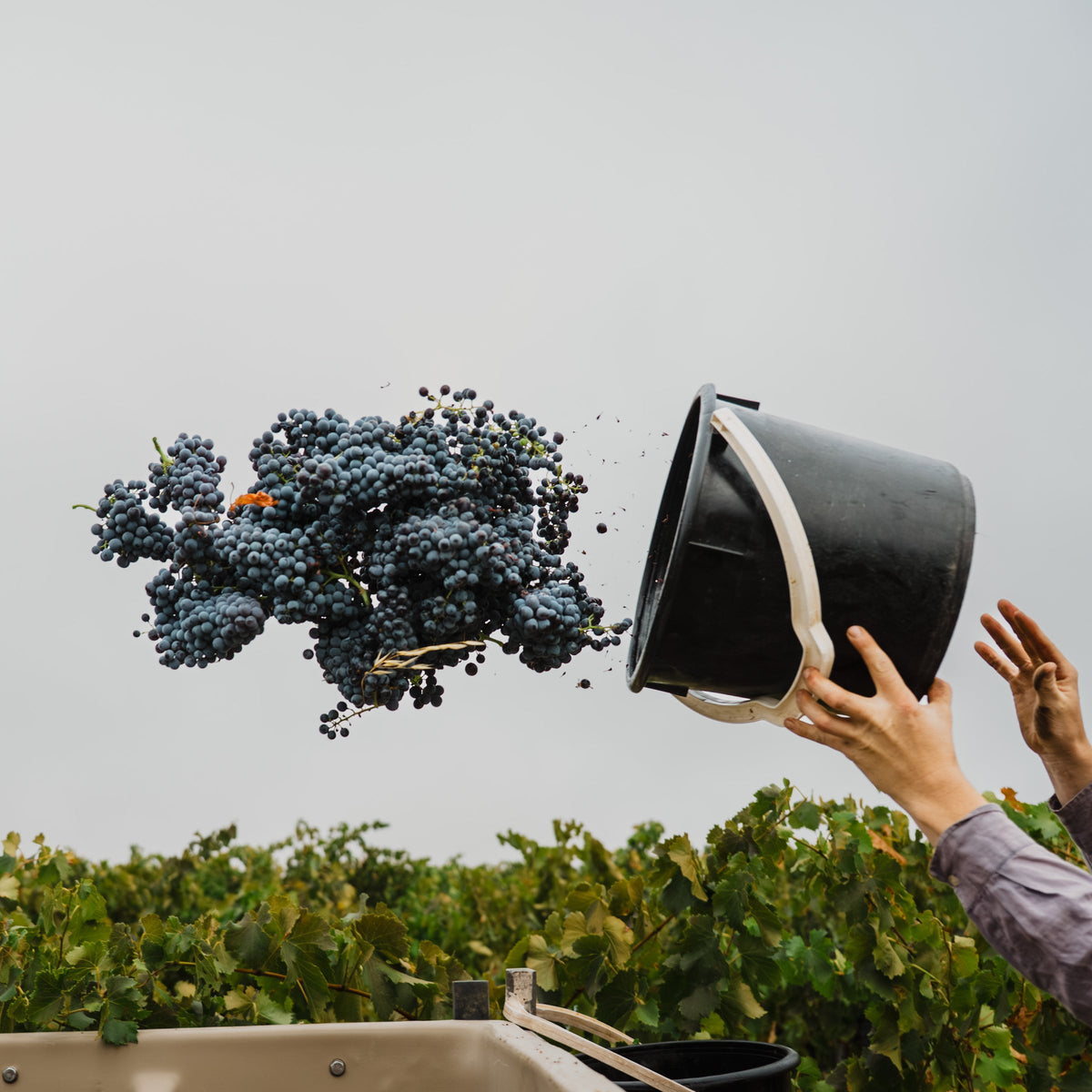
In a grape, it lives in the skin, and it is there for a reason. Quercetin is sunscreen. The vine produces it in response to ultraviolet light, which means the amount in any given bunch is largely a function of how much sun that bunch saw.
That is what makes it unusual as a wine compound. Most of what we talk about at a tasting bench is decided in the cellar: the vessel, the ferment, the time on skins. Quercetin is decided in the row. How much leaf you pull, which side of the canopy you open up, how exposed you leave the fruit through summer. Those are the levers.
It also explains why red wine carries far more of it than white. Red winemaking leaves the juice in contact with the skins. White winemaking largely does not, and the skins are where the compound is.
Then, the enzyme
Your body breaks down alcohol in two steps. First, ethanol becomes acetaldehyde. Then acetaldehyde becomes acetate, which is harmless and easily cleared.
Acetaldehyde, the thing in the middle, is not harmless. It is considerably more toxic than the alcohol it came from, and the enzyme responsible for clearing it is called ALDH2.
ALDH2 is worth knowing about in its own right, entirely separately from wine. It carries one of the most studied variants in human genetics. The ALDH2*2 variant leaves the enzyme working poorly, and it is estimated to affect around 540 million East Asians, roughly 8% of the world's population. A further 120 million people of other ancestry, about 1.5% of the world, carry different variants that also reduce ALDH2 activity.
If you have ever watched someone go red in the face and get a thumping head after half a glass, that is this enzyme. Acetaldehyde builds up because there is nothing efficient to clear it. It is commonly called the alcohol flush reaction, and it is a genuine and well-documented piece of human biology rather than a curiosity.
Where the two meet
In November 2023, Apramita Devi, Morris Levin and Andrew Waterhouse at UC Davis published work in Scientific Reports looking at what quercetin does to that enzyme.
When you drink wine, your body does not leave quercetin as it found it. It converts it into a metabolite, quercetin-3-glucuronide. The study tested that metabolite against ALDH2 and found it inhibited the enzyme with an IC50 of 9.62 micromolar.
The detail we find most interesting is the comparison. Plain quercetin, unconverted, came in at 26.50 micromolar, which is to say considerably weaker. It is not the compound in the wine that does the blocking. It is what your body makes out of it.
What is not known
This was laboratory work. It establishes that the inhibition happens in a test, not that it happens in a person drinking a glass of red.
The authors are direct about that. Their paper states plainly that human-subject testing is needed to test the hypothesis, and to our knowledge nobody has run it. The trial they describe is simple enough: take people, give them two red wines, one high in quercetin and one low, and see what actually occurs.
Until that exists, this sits where it belongs, as a promising line of enquiry with a plausible mechanism behind it. There are also several reasons individuals might respond differently that have nothing to do with the wine at all, including how each person absorbs quercetin and how efficiently their own ALDH2 works.
Why we are paying attention
Not because it sells anything. It does not, and we would rather say so than pretend otherwise.
We are interested because quercetin is a farming output. If this line of research firms up over the next few years, a set of decisions we already make every summer about leaf and light and exposure would turn out to have a compositional consequence nobody was measuring. That is a genuinely novel thought for anyone who grows fruit.
We have never measured quercetin in our wines. Almost nobody has, outside research settings. We are not going to imply anything about ours that we have not tested.
What we would say is that this particular enzyme is worth reading about on your own. It sits at the junction of genetics, metabolism and what ends up in a glass, and the literature on it is far richer and stranger than one wine study. The papers below are a reasonable place to start.
If the vineyard side is what interests you, the vineyards are where those decisions get made, and you are welcome to come and look at them from the cellar door.
Please drink responsibly. Nothing on this page is health advice and none of it is a reason to choose one wine over another. If alcohol reliably makes you unwell, that is a conversation for your doctor.
Worth reading
- Devi A, Levin M, Waterhouse AL. Inhibition of ALDH2 by quercetin glucuronide suggests a new hypothesis to explain red wine headaches. Scientific Reports, 20 November 2023.
- Chen CH, Kraemer BR, Mochly-Rosen D. ALDH2 variance in disease and populations. Disease Models & Mechanisms, 2022;15(6):dmm049601. The source of the population figures above.
- McGill University Office for Science and Society, on why the hypothesis is not yet settled.
Read more

A long, lazy Sunday roast made for sharing, and the perfect excuse to open a bottle of GSM. Kylie Tscharke's family recipe for slow-cooked Weber leg of lamb.
A long, lazy Sunday roast made for sharing, and the perfect excuse to open a bottle of GSM. Kylie Tscharke's family recipe for slow-cooked Weber leg of lamb.